Meta's Business AI Hit 10M Weekly Conversations in Q1
Meta’s free AI tools for small businesses reached 10 million customer conversations per week by late March 2026 — up from 1 million at the start of the year. CEO Mark Zuckerberg disclosed the figure on Meta’s Q1 2026 earnings call on April 29, framing the 10x quarterly jump as validation of a deliberate strategy: give AI away free to build scale, then monetize. Executives whose businesses touch Meta’s platforms should take that math seriously.
Key takeaways:
- Meta’s business AI tools handled 10 million conversations per week by late March 2026, up from 1 million in January — a 10x increase in a single quarter.
- The tools are free today and run on WhatsApp, Instagram, and Messenger for any business on Meta’s platforms.
- Zuckerberg signaled on the April 29 earnings call that paid tiers are coming, without giving a timeline.
- Meta beat Q1 2026 expectations with $56.31 billion in revenue and EPS of $10.44, but its stock fell roughly 10% on raised capex guidance.
- Industries with heavy WhatsApp or Instagram customer contact — retail, hospitality, e-commerce, professional services — face direct competitive pressure from this shift.
What does Meta’s business AI actually do?
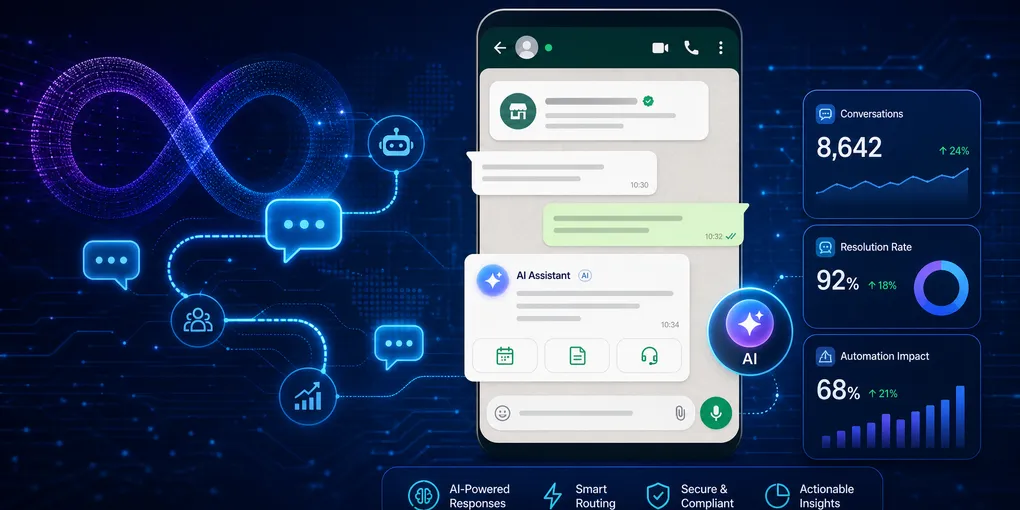
The tools operate as AI-powered customer service agents embedded inside WhatsApp, Instagram Direct, and Messenger. A customer messages a local restaurant, boutique, or service provider, and the AI responds — answering questions about availability, pricing, or products. No human needs to be on the other end.
Meta’s tools are built on its own Llama family of models and are available free to any business already on its platforms. The setup bar is low: connect a product catalog, configure basic responses, and the AI handles incoming inquiries automatically.
In its January 2026 strategy outline, Meta described plans to expand beyond Q&A into transactional capabilities — helping customers “get things done directly in WhatsApp,” including completing purchases. The 10 million weekly conversations reflect the Q&A stage. The transactional layer is what Zuckerberg is building toward.
Why did 10x growth happen in one quarter?
Three factors drove the acceleration — and they’re structural advantages no AI startup can replicate:
Distribution without acquisition costs. Meta doesn’t need to convince customers to install something new. Billions of people are already inside WhatsApp and Instagram. When a business activates Meta’s AI tools, it goes live where customers already are. That’s fundamentally different from deploying a third-party chatbot that requires directing customers to a new channel.
Zero cost removes the decision friction. A small business owner evaluating an AI customer service tool from a standalone vendor faces setup costs, integration work, and a monthly bill. Meta’s version has none of that. The barrier between “thinking about it” and “using it” effectively disappeared.
Active distribution through the advertiser base. Meta’s business AI isn’t just available — Meta is actively surfacing it to the millions of businesses that already run advertising on its platforms. It has a direct channel to its potential customers that most enterprise software companies would spend billions to acquire.
What does this mean for executives?
Two practical implications:
Competitors may already be running AI customer service on Meta — for free. If your business operates in retail, food and beverage, hospitality, or professional services, there is a reasonable chance that some of your competitors have activated these tools. A customer who sends WhatsApp messages to three local options and gets an instant AI response from one and silence from the others is not a neutral comparison. Response time and completeness of information are real competitive levers, and Meta just made them free for one side.
Free today is a market capture strategy, not a permanent price point. Zuckerberg was direct on the earnings call about monetization being planned. Meta committed $125–$145 billion in capital expenditure for 2026 — a $10 billion increase from its prior estimate. Running AI at 10 million conversations a week, growing rapidly, requires infrastructure. The infrastructure costs money. Eventually, so will the tools. Businesses building workflows and customer expectations around free Meta AI should plan for a cost structure that doesn’t yet exist.
This dynamic — free AI tools from platform incumbents, offered at scale to build dependency before monetization — is a pattern playing out across the AI landscape in 2026. Meta is the version of it that reaches the most small businesses fastest.
Is Meta’s business AI ready for serious enterprise use?
For small business customer service, the answer is already yes — the usage numbers confirm adoption at real scale. For larger enterprises, the picture is more nuanced.
The tools are optimized for the kind of customer interactions that happen inside Meta’s consumer apps: conversational, informal, relatively simple requests. Enterprise use cases with complex product catalogs, regulatory requirements, or multi-step workflows would need more customization than Meta’s current free tools offer.
The more significant enterprise consideration is channel strategy: if your customers are reaching out on WhatsApp, you need to be there with AI or cede that touchpoint to competitors who are. AI agents are increasingly the front line of customer service — Meta just made deploying one on the world’s most-used messaging platform nearly frictionless.
Frequently asked questions
What does Meta’s business AI actually do for small businesses?
Meta’s business AI acts as an automated customer service agent inside WhatsApp, Instagram, and Messenger. When a customer messages a small business, the AI responds — answering product questions, checking availability, and handling simple requests. Meta also plans to expand it into transactional tasks, so customers can complete actions directly inside WhatsApp. It’s built on Meta’s Llama models and is currently free.
How much did Meta’s business AI usage grow in Q1 2026?
Usage grew 10x in a single quarter — from 1 million weekly customer conversations in January 2026 to 10 million by late March 2026. Meta CEO Mark Zuckerberg disclosed the figure on the Q1 2026 earnings call on April 29. The growth reflects both Meta’s massive existing user base and the zero-cost barrier for businesses to activate the tools.
Is Meta’s business AI really free, or will they charge for it later?
It is free now, but Zuckerberg explicitly signaled monetization is coming. Meta raised its 2026 infrastructure budget to $125–$145 billion, and Business AI is central to how it plans to generate returns on that investment. The current free model is a market capture strategy — businesses should expect pricing to be introduced as the product matures.
Which industries should pay attention to Meta’s business AI?
Industries with strong WhatsApp or Instagram customer communication — retail, hospitality, e-commerce, and professional services — face the most immediate competitive pressure. The zero-cost barrier means competitors may already be running AI-powered customer service. A business not using these tools is potentially at a disadvantage in response speed and availability today.
How did Meta perform financially in Q1 2026?
Meta beat Q1 2026 revenue expectations with $56.31 billion in revenue and EPS of $10.44. The strong quarter came alongside the Business AI milestone, reinforcing Zuckerberg’s argument that giving AI tools away free to businesses can be a viable long-term platform strategy. The stock fell roughly 10% post-earnings, driven by investor concern over the raised capex guidance.
By Advanced AI · May 1, 2026 · Industry News