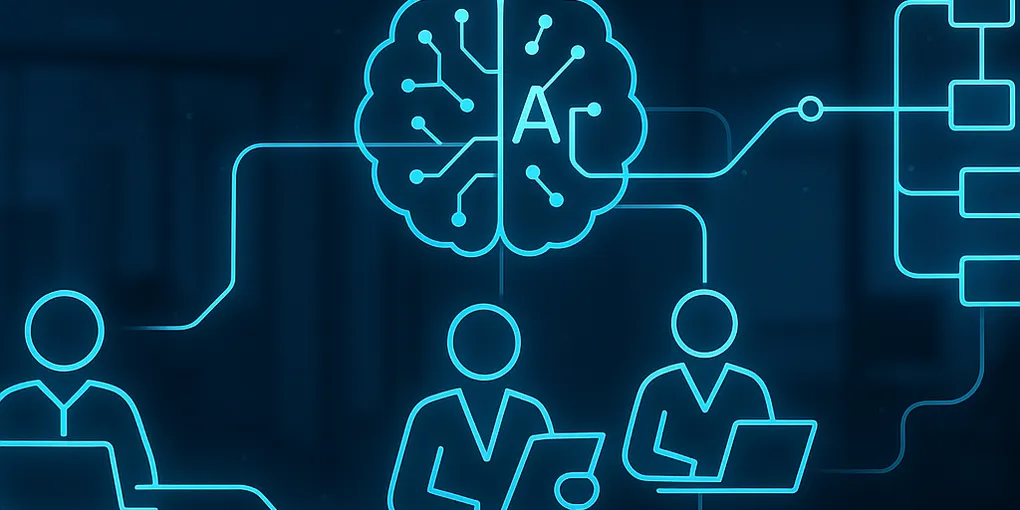
AI Agents Are No Longer Copilots — They Are Executing Your Business Processes
AI agents are no longer just suggesting actions — they are completing them. In 2026, autonomous AI agents read emails, query internal systems, make decisions, and log actions without waiting for human sign-off at each step. This shift from copilot-style assistance to autonomous execution is the most consequential change in enterprise AI since the introduction of LLMs — and most organizations aren’t ready for what it demands.
Key Takeaways
- AI agents now execute multi-step business processes end-to-end, without human approval at each step.
- The failure mode of autonomous agents is different: mistakes happen before anyone reviews them, at machine speed.
- Governance is non-negotiable: define what agents can do independently, what requires human approval, and how exceptions are handled.
- SMBs should start with repetitive, low-stakes tasks — order confirmations, customer inquiry routing, inventory alerts.
- Integration depth and audit trails matter more than interface quality when evaluating agent platforms.
Why Is the Copilot Era Winding Down?
Copilot-style AI — tools that suggest, assist, and autocomplete — was the right design for a world where AI models were impressive but unreliable. You kept a human in the loop because the AI might hallucinate, miss context, or make a decision you’d regret.
That design constraint is loosening. As SAP noted in its 2026 enterprise AI briefings, the shift has moved to “execution, not experimentation.” The latest generation of AI models — including Claude Sonnet, GPT-4o, and Gemini 2.0 (all as of early 2026) — are capable of executing multi-step reasoning tasks with greater consistency than earlier generations, making autonomous deployment more practical for real business processes.
The result: autonomous agents that don’t wait for you to approve each step. They execute.
What Changes When AI Executes?
This shift changes the nature of the risks involved — and the governance structures required.
With copilots, mistakes are caught before they happen. A human reviews before acting. The failure mode is inefficiency: the human misses something the AI flagged, or doesn’t use the tool at all.
With autonomous agents, mistakes happen before they’re caught. An agent that books the wrong vendor, sends the wrong pricing, or makes an unauthorized exception has already acted. The failure mode is consequential action at machine speed.
This is not an argument against autonomous agents. It’s an argument for building the right guardrails before deploying them at scale. For a foundational understanding of how agents work technically, see our explainer on how AI agents work.
The Governance Framework You Need
Three decision points every organization must define before deploying autonomous AI agents:
1. Where can machines act independently?
Not every business process carries the same risk if an AI makes an error. Triaging support tickets, categorizing leads, generating first drafts, pulling reports — these are low-risk autonomous actions. Define your safe-to-automate tier and let agents run there without human checkpoints.
2. Where must humans approve?
Contracts above a dollar threshold, communications to key accounts, any action that modifies financial records, anything with legal exposure — these need a human in the loop. This isn’t about distrust of AI; it’s about risk management, compliance, and maintaining accountability.
3. How are exceptions handled?
Every autonomous agent will eventually hit a scenario outside its parameters. What happens then? Does it halt and escalate? Does it make a conservative choice and notify? Does it attempt the action anyway? Define this before your agents encounter it in production.
The Small Business Reality
For small and mid-size businesses, the calculus is different — but the urgency is the same.
The U.S. Chamber of Commerce projects AI adoption among SMBs will accelerate in 2026, particularly in marketing automation, HR screening, customer service, and logistics coordination. The businesses that capture the ROI aren’t the ones that adopted AI earliest — they’re the ones that deployed it in the right places first.
A practical starting framework for SMBs:
Start with repetitive, high-volume, low-stakes tasks. Order confirmation emails, social media scheduling, basic customer inquiry responses, inventory alerts. These are where autonomous agents deliver immediate ROI without significant risk.
Build confidence before expanding scope. Run agents in “shadow mode” — executing behind the scenes while a human reviews outputs — before giving them live access. This builds your team’s confidence and surfaces edge cases before they become incidents.
Document what your agents are authorized to do. When an agent acts, who is responsible? This needs a clear answer before something goes wrong.
What Does This Mean for Your Technology Stack?
The shift from copilots to autonomous agents has implications for the tools you choose:
-
Integration depth matters more than interface quality. An agent that can’t connect to your actual systems — your CRM, your ERP, your email — is a demo, not a worker. Evaluate AI platforms on their native integrations.
-
Audit trails become non-negotiable. Knowing what your agents did, when, and why is critical for debugging, compliance, and continuous improvement. If a platform doesn’t log agent actions in a reviewable way, don’t deploy it in production.
-
Model quality has a floor. The autonomous agent use case requires models that are reliably good, not occasionally great. Prioritize consistency over peak performance.
For a broader view of where AI stands in 2026 across industries, see our 2026 AI landscape overview.
The Bottom Line
The question in 2025 was “should we be using AI?” The question in 2026 is “what are we letting AI do on its own?”
Organizations that answer this thoughtfully — with clear authorization boundaries, exception handling, and audit infrastructure — will capture the productivity gains without the operational surprises. Organizations that skip governance entirely will find autonomous agents creating risk at the same speed they create efficiency.
The era of AI execution is here. The organizations that thrive in it will be the ones that took governance seriously before it was required.
Frequently Asked Questions
What’s the difference between an AI copilot and an AI agent?
A copilot suggests or assists — you still click “approve.” An AI agent acts on its own: it can read your email, update your CRM, send a response, and log the action without waiting for human sign-off at each step. The shift is from AI as a tool you use to AI as a process that runs itself.
What kinds of tasks are AI agents actually ready to handle on their own?
Repetitive, high-volume, low-stakes tasks are the safest starting point — order confirmation emails, social media post scheduling, and routing basic customer inquiries. These have clear rules, low consequence if something goes slightly wrong, and enough volume that automation saves real time.
Why are autonomous AI agent mistakes harder to catch than regular AI mistakes?
Because they happen before anyone reviews them, and at machine speed. A copilot error sits in a draft waiting for your approval. An agent error is already sent, logged, or executed by the time a human notices. That’s why audit trails and authorization limits need to be in place before deployment, not after.
What governance do businesses need before deploying AI agents?
Three things: clear boundaries on what actions agents can take independently, defined human-approval checkpoints for higher-stakes decisions, and exception-handling protocols for when something falls outside the agent’s parameters. Without these, autonomous agents create risk at the same speed they create efficiency.