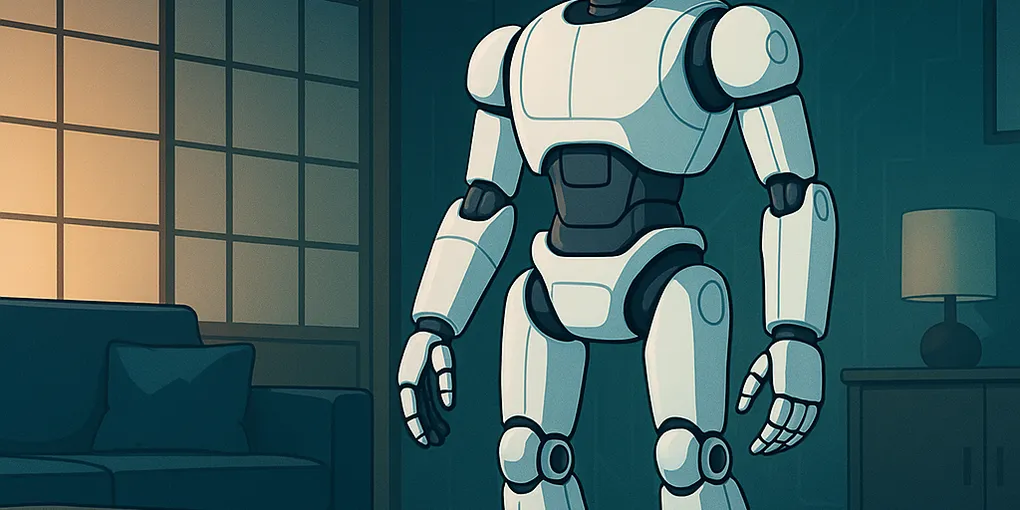
UniX AI Panther: The First Humanoid Robot Actually Deployed in Homes
UniX AI’s Panther is in real homes — not factory floors, research labs, or produced demo videos. Announced on April 8, 2026, the Panther is UniX AI’s third-generation full-size service humanoid: a wheeled, dual-arm robot that the Suzhou-based company claims is the world’s first service humanoid to enter real household deployment at scale. For anyone tracking when home robotics moves from concept to product, this is the milestone to watch.
Key Takeaways
- UniX AI Panther launched April 8, 2026 — a wheeled, dual-arm humanoid in real homes.
- Wheeled design chosen for domestic reliability over legged complexity and fall risk.
- Current use cases: elderly care assistance, light domestic tasks, concierge roles.
- AI vision-language models (as of 2024–2026) enable real-time home environment interpretation.
- China’s robotics supply chain cost reductions are making household deployment economically viable.
What Makes the UniX AI Panther Different From Other Humanoid Robots?
The design choice that sets Panther apart is immediately visible: it’s wheeled, not legged.
This isn’t a compromise — it’s a deliberate engineering decision that prioritizes utility over spectacle. Legged robots can handle stairs and uneven terrain, but they’re mechanically complex, expensive to maintain, and prone to falls. In a home environment with hardwood floors, rugs, and elderly users, a wheeled base is simply more reliable and practical.
Panther’s dual-arm architecture — two fully articulated arms mounted on that stable wheeled platform — gives it the reach and dexterity needed for domestic tasks: carrying items, opening doors, and interacting with household objects. The “humanoid” framing refers to the arms and upper body, designed to operate in spaces built for humans rather than bipedal locomotion.
This mirrors the strategic pragmatism NVIDIA has applied to its robotics infrastructure — as covered in our NVIDIA physical AI roundup: the most deployable robot wins, not the most impressive-looking one.
Why Is Household Robotics Happening Now?
The household robotics market has been “five years away” for about twenty years. What changed?
AI models reached production quality. Modern vision-language models, deployed commercially since 2024, can interpret home environments in real time, understand natural language instructions, and handle edge cases that previously required explicit programming. Panther runs on this generation of AI inference — a capability that didn’t exist at production quality before 2024.
The cost curve moved. Manufacturing improvements in China’s robotics supply chain — the same ecosystem that enabled affordable EVs — are now driving down the cost of actuators, sensors, and chassis components. What cost $100,000+ to prototype in 2022 can now be manufactured at a fraction of that, according to industry analysts.
Demographic demand is real. Aging populations across Japan, South Korea, and Europe are creating genuine urgency around domestic assistance robots. This isn’t a luxury play — it’s a demographic response to caregiver shortages that traditional staffing can’t address at scale.
What Can the Panther Actually Do in a Home?
UniX AI is positioning Panther as a “service humanoid” — useful for defined tasks rather than a general-purpose household assistant. Early deployment scenarios include:
- Elderly care assistance: fetching items, mobility monitoring, companionship
- Light domestic tasks: carrying groceries, organizing household items
- Reception and concierge roles in residential buildings
It’s not doing laundry or cooking dinner — not yet. But it’s operating in real homes and collecting real-world data that will accelerate every subsequent version. That data advantage compounds: the more homes Panther operates in, the better its AI models become at handling the unpredictability of domestic environments.
How Does Panther Compare to Tesla Optimus and Boston Dynamics?
Panther enters a fast-moving competitive field:
- Tesla’s Optimus is expanding factory testing for autonomous material handling, targeting industrial rather than domestic use
- Figure AI and Boston Dynamics are focused on industrial and logistics applications; Boston Dynamics’ Spot has been in commercial deployment for years as a quadruped
The household deployment angle is where Panther stands out. Getting a humanoid robot into actual domestic environments — not a showroom, not a controlled pilot — is a meaningful milestone. The real-world behavioral data collected there will be invaluable for training future generations, creating a data moat similar to what early AI adopters are building in enterprise software (see PwC’s analysis of AI value concentration).
What Does This Signal for the Robotics Industry?
For businesses in robotics distribution, education, and adjacent markets:
The timeline is compressing. Household humanoids were a “2030 problem” eighteen months ago. Panther is a 2026 reality.
Design pragmatism wins. Wheeled platforms will dominate service robotics for the next several years before legged designs catch up on cost and reliability.
Software is the differentiator. Hardware is converging across manufacturers. The companies that win will be the ones with the best AI models, the richest real-world training data, and the fastest iteration loops.
Frequently Asked Questions
Is the UniX AI Panther actually in people’s homes, or just a prototype?
It’s deployed in real homes. UniX AI’s Panther began actual household deployment on April 8, 2026, making it the first humanoid robot confirmed in domestic use rather than just lab or industrial pilots. This real-world deployment also lets the company collect live behavioral data to improve future performance.
Why does the Panther have wheels instead of legs?
UniX AI chose wheels over legs to prioritize reliability in home environments. Legged robots are more mechanically complex and prone to falls — a serious concern in homes with elderly users. The wheeled design trades some terrain flexibility for far greater stability and lower maintenance risk in everyday domestic settings.
How is the Panther different from Tesla Optimus or Boston Dynamics robots?
The key difference is deployment context. Tesla Optimus and Boston Dynamics robots primarily target industrial and logistics environments. The Panther is purpose-built for households, handling elderly care, light chores, and concierge tasks — and unlike its competitors, it’s already operating in real homes rather than controlled test sites.
What can the UniX AI Panther actually do inside a house?
The Panther handles elderly care assistance, light domestic tasks, and concierge-style functions like greeting and guidance. It uses AI vision-language models (as of 2024–2026) to interpret its environment in real time, allowing it to respond to dynamic home conditions rather than operating on rigid pre-programmed routines.
The Bottom Line
Panther is a signal, not just a product. The household robotics era isn’t coming — it’s here. UniX AI has demonstrated that a wheeled humanoid running on modern AI can operate in real homes today. The question for businesses and investors in the robotics space isn’t whether this market will materialize. It’s whether you’ll be positioned when it scales.