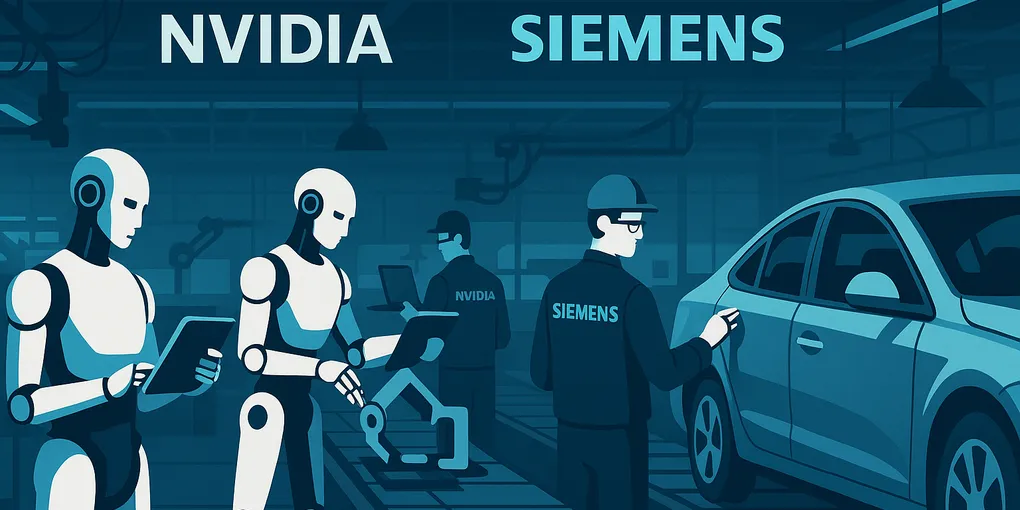
Siemens and NVIDIA Just Put Humanoid Robots on a Live Factory Floor
Siemens, NVIDIA, and UK robotics startup Humanoid have deployed an AI-powered robot on a live production floor at Siemens’ electronics factory in Erlangen, Germany. The HMND 01 Alpha robot completed an eight-hour factory shift performing real logistics tasks alongside human workers — announced publicly at Hannover Messe 2026.
Key takeaways:
- The HMND 01 Alpha robot completed an eight-hour live shift at Siemens’ Erlangen factory in Germany.
- NVIDIA’s Isaac Sim handled simulation-first training; edge inference runs locally on-device.
- Siemens provides industrial integration, safety frameworks, and manufacturing credibility.
- Hyundai (Boston Dynamics’ owner) is reportedly targeting 30,000 Atlas units annually by 2028.
- This is production deployment, not a staged demo — robots performed real operational tasks.
What’s Actually Happening
NVIDIA’s physical AI stack powers the deployment. The system uses:
- Simulation-first training — robots are trained in NVIDIA’s Isaac Sim virtual environment, which models physics, lighting, and material properties at high fidelity before the robot ever touches real hardware
- Real-time edge inference — once deployed, the robots run inference locally at the edge, avoiding cloud roundtrips that introduce latency
- Perception, reasoning, and adaptation — the design goal is robots that can perceive their environment, reason about what’s happening, and adapt in real time alongside human workers
Siemens provides the industrial integration — factory systems, safety frameworks, and the operational expertise to run hardware in production settings. The combination is deliberate: NVIDIA supplies the AI stack, Humanoid supplies the robot hardware, and Siemens supplies the manufacturing credibility. Per the official Siemens press release, the robot performed real operational tasks within an active workflow — not a controlled demonstration.
Why Does This Deployment Differ From Previous Announcements?
The robotics space has produced impressive demos for years. Various platforms can perform warehouse tasks, navigate obstacles, and handle objects in controlled environments. But demo and production deployment are not the same thing.
What makes this announcement notable is the explicit focus on meeting real production targets in a live factory. This isn’t a pilot to generate press — it’s a trial designed to hit actual manufacturing KPIs at a facility where mistakes cost money. Euronews frames the central question accurately: can AI robots reliably work alongside humans on a real production schedule?
The physical AI supply chain is also maturing rapidly. Hyundai — which owns Boston Dynamics — is reportedly targeting 30,000 Atlas units annually by 2028, with production planned for its Metaplant facility near Savannah, Georgia. Hyundai’s MobED mobile robot platform was also set for commercialization in early 2026. The infrastructure enabling scale — chips, simulation platforms, training pipelines, safety certification — is converging faster than most industry timelines predicted.
For context on how humanoid robots are entering industrial settings more broadly, see our coverage of humanoid robots entering the workplace in 2026 and NVIDIA’s physical AI robotics push at CES and beyond.
What Does NVIDIA’s Role Mean for Physical AI?
NVIDIA’s involvement is worth unpacking. The company has made a sustained, strategic bet on physical AI — the idea that the next wave of AI value won’t come from language models alone, but from AI systems that operate in the physical world.
Their Isaac Sim platform, Omniverse for factory digital twins, and Jetson edge compute hardware fit together into a coherent stack. What Siemens has deployed is essentially a complete physical AI pipeline running on NVIDIA infrastructure — which is exactly what NVIDIA has been building toward. As of April 2026, NVIDIA’s Isaac Sim and related physical AI tools represent the most mature commercially deployed end-to-end stack for training and deploying robots in industrial environments.
For NVIDIA investors and competitors, this matters. If physical AI becomes as significant as cloud AI, NVIDIA’s hardware advantages in training and inference extend directly into robotics, autonomous vehicles, and industrial automation.
What Should Manufacturing Businesses Do Now?
If you run or advise manufacturing operations, several things are worth considering:
The adoption timeline has compressed. Many industry analysts projected humanoid robots in real factories as a 5–10 year story. The Siemens/NVIDIA/Humanoid deployment suggests we’re closer to 2–3 years for adoption in specific task categories.
Skills gaps will shift. The near-term labor shift isn’t simply “robots replacing workers” — it’s robots handling high-repetition, physically demanding tasks while workers move into robot oversight, maintenance, and process design roles. The required skill set changes, but employment shifts rather than disappears in the near term.
Enterprise AI vendors are moving into physical space. If your AI strategy is purely digital — customer service bots, document processing, analytics — watch this space. The companies building physical AI infrastructure today will have structural advantages in industrial markets within a few years.
Simulation-first is the key insight. The reason NVIDIA’s approach works is that training in simulation is cheaper, faster, and safer than training in the real world. This principle applies broadly to any domain where physical testing is expensive — logistics, construction, agriculture. Simulation-first training is a design pattern worth understanding regardless of industry.
What to Watch Next
The critical question is whether this trial meets its production targets. If Siemens publicly confirms the deployment achieved its KPIs, expect rapid expansion — both within Siemens facilities and across the broader manufacturing sector.
Watch for:
- Siemens publishing performance data from the Erlangen trial
- NVIDIA announcing additional manufacturing partners using the same stack
- Competing physical AI stacks from Google DeepMind, Tesla (Optimus), and Chinese manufacturers — AGIBot has already announced plans for 10,000 robot deployments — accelerating their roadmaps in response
The factory floor has become a proving ground for physical AI. The results of this trial will shape how aggressively industrial companies invest in humanoid robotics over the next 24 months.
Frequently Asked Questions
What did the Siemens and NVIDIA humanoid robot actually do on the factory floor?
The HMND 01 Alpha robot completed a full eight-hour shift performing real logistics tasks alongside human workers at Siemens’ electronics factory in Erlangen, Germany. This was a live production deployment — not a controlled demo — announced publicly at Hannover Messe 2026.
What is NVIDIA Isaac Sim and why does it matter for robotics?
Isaac Sim is NVIDIA’s simulation platform used to train robots in virtual environments before they touch real hardware. In the Siemens deployment, robots were trained via simulation first, then run inference locally on-device at the edge. As of April 2026, it’s considered the most mature end-to-end stack for industrial robot training and deployment.
How many humanoid robots is Hyundai planning to produce?
Hyundai, which owns Boston Dynamics, is reportedly targeting production of 30,000 Atlas units annually by 2028. That scale signals the industry is moving from prototype milestones toward volume manufacturing.
Will humanoid robots replace factory workers?
The near-term shift isn’t straight replacement — it’s task reallocation. Humanoid robots are being deployed for high-repetition logistics work, while human workers move into oversight and exception-handling roles. The Siemens deployment follows this pattern, with the robot working alongside humans, not instead of them.