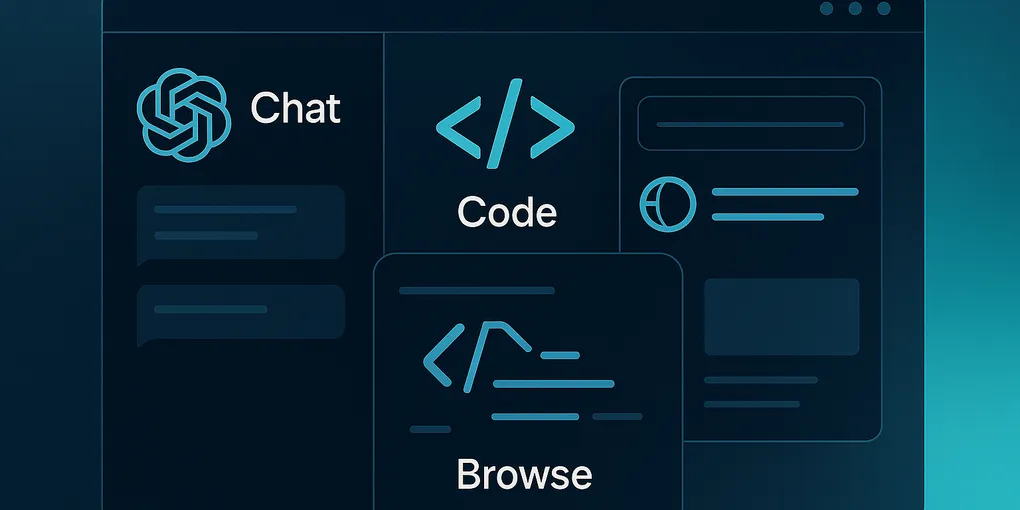
OpenAI Is Building a Superapp: ChatGPT, Codex, and Atlas Browser Are Merging
The browser-tab era of AI is ending. According to reporting from The Verge and CNBC, OpenAI plans to consolidate ChatGPT, Codex (its AI coding assistant), and the Atlas browser into a single desktop application — a move aimed squarely at Anthropic, which has built a loyal following among developers and power users through Claude’s native desktop app.
Key takeaways:
- OpenAI plans to merge ChatGPT, Codex, and the Atlas browser into one desktop superapp.
- The Atlas browser (as of April 2026) already lets AI agents navigate the web and take actions on your behalf.
- Anthropic’s Claude desktop app has strong developer adoption; OpenAI is attempting to recapture that audience.
- Google is accelerating Gemini’s desktop presence — all three major AI players are competing for the OS layer.
- For enterprises, a unified platform simplifies procurement and keeps session context across tasks.
At the same time, Google is doubling down on Gemini’s desktop presence. The AI assistant wars, which started as a contest between web products, are now a competition for the desktop OS layer.
What’s Being Built
OpenAI’s planned superapp would combine:
- ChatGPT — the conversational AI most people know, now with multimodal capabilities, memory, and voice
- Codex — OpenAI’s AI coding agent (as of April 2026), currently available as a separate product that can write, test, and deploy code autonomously
- Atlas — OpenAI’s browser product, which gives the AI the ability to navigate the web, interact with websites, and take actions on your behalf
Together, these aren’t just three products jammed into one window. They represent a coherent AI operating layer: you can have a conversation, ask it to write and run code, and have it browse the web for current information or take web-based actions — all in a single interface, without switching contexts.
(Atlas is already a standalone product as of April 2026, with an agent mode that can click, fill forms, and complete tasks in the browser. The superapp would unify it with the rest of OpenAI’s stack.)
Why Does Anthropic’s Desktop Presence Matter?
Anthropic has been playing a longer game here than most people noticed. While ChatGPT dominated the browser and mobile experience, Anthropic invested heavily in Claude’s native desktop app — a polished, fast, keyboard-shortcut-accessible experience that developers and knowledge workers adopted in significant numbers.
The result: among serious daily users, Claude’s desktop app has cultivated a loyal base that OpenAI is now explicitly working to recapture. Claude Code’s recent multi-agent redesign is a clear signal that Anthropic is doubling down on the power-user desktop experience — making OpenAI’s move all the more urgent.
This dynamic also explains why Google is accelerating Gemini’s desktop efforts. All three major AI players now recognize that whoever owns the desktop shortcut owns the workflow.
What’s the Strategic Logic Behind a Superapp?
From OpenAI’s perspective, the superapp strategy solves several problems at once:
Fragmentation. Right now, a power user might use ChatGPT for conversation, a separate Codex interface for coding, and a different tool for web browsing. Unifying these reduces friction and keeps users in the OpenAI ecosystem rather than mixing tools.
Competitive differentiation. Anthropic’s Claude can do many of the same things, but doesn’t yet have a fully integrated coding agent and browser in a single package. A unified product could give OpenAI a feature advantage — at least temporarily.
Enterprise stickiness. For business buyers, a single vendor providing conversation, coding, and web automation is a simpler procurement conversation than three separate tools. The superapp is also an enterprise pitch.
OS-layer presence. The endgame isn’t just an app — it’s becoming the default AI layer that sits between users and their computers. Microsoft is pursuing the same goal through Copilot integration in Windows. Apple is pursuing it through Apple Intelligence in macOS and iOS. OpenAI’s superapp is their attempt at the same position without OS-level control.
What This Means for Users and Businesses
For everyday users: The shift to native desktop apps means AI that’s faster, more integrated with local files, and available via keyboard shortcuts without opening a browser. If you haven’t tried a native AI desktop app, you’ll likely find it meaningfully better than the web version.
For developers: Codex integrated into the same interface as ChatGPT means more seamless movement between “explain this” and “build this.” According to recent research on AI coding tools, AI-assisted coding tools are already cutting routine development time significantly — and browser integration means agents that can actually look things up and interact with web-based tools on your behalf. The Wired review of Atlas notes that its agent mode can click around and complete tasks independently.
For business buyers: A unified platform from OpenAI simplifies vendor management. It also means your team’s conversation history, code output, and browsed research could all live in the same session context — which has real workflow implications for research-heavy and development-heavy teams.
For IT and security teams: A superapp with browser capabilities means AI that can take actions on the web — filling forms, logging into services, interacting with third-party tools. The security implications of that are significant and not yet fully understood. Expect access controls and audit logging to become major features (and major concerns) as this category matures.
The Broader Pattern
What’s happening with OpenAI, Anthropic, and Google isn’t just product competition — it’s a fundamental question about where AI lives in people’s daily work.
The browser-first era of AI made sense when these tools were novelties. As AI becomes genuinely useful for sustained, complex work, the friction of browser tabs and separate apps becomes a real limitation. Native, deeply integrated desktop experiences reduce that friction.
The companies that win the desktop layer will have a substantial advantage in capturing daily active use, habit formation, and ultimately enterprise contracts. The fact that all three major AI players are moving aggressively in this direction at the same time tells you everything about where the competitive energy is focused.
OpenAI’s superapp isn’t just a product announcement. It’s a declaration that the web-app phase of AI is over, and the platform phase has begun.
Frequently Asked Questions
What is OpenAI’s superapp?
OpenAI’s planned superapp is a single desktop application that merges ChatGPT, the Codex AI coding agent, and the Atlas browser. Instead of switching between three separate tools, users would handle conversation, code generation, and web browsing all in one interface.
Has OpenAI officially announced the superapp?
As of April 2026, OpenAI has confirmed internally that the superapp is in development, per reporting by The Wall Street Journal, corroborated by The Verge, CNBC, and Engadget. A public launch date has not been announced.
What is ChatGPT Atlas?
Atlas is OpenAI’s standalone web browser, launched with ChatGPT built into its core. It includes a sidebar for asking questions about any web page, plus an agent mode that can click, fill forms, and complete tasks in the browser on your behalf.
Why is OpenAI building a desktop superapp now?
Anthropic’s Claude desktop app gained strong traction among developers and power users — a segment OpenAI wants to recapture. A unified desktop product also simplifies the enterprise sales pitch and positions OpenAI to compete with Microsoft Copilot and Apple Intelligence at the OS layer.
What are the security concerns around an AI superapp with browser access?
When AI agents can log into services, fill forms, and interact with web tools on your behalf, the attack surface expands significantly. Security teams should expect access controls, permission scoping, and audit logging to become critical features as agentic desktop apps mature.