Hyundai Pledges $26B in U.S. AI and Robotics — What It Signals for Business
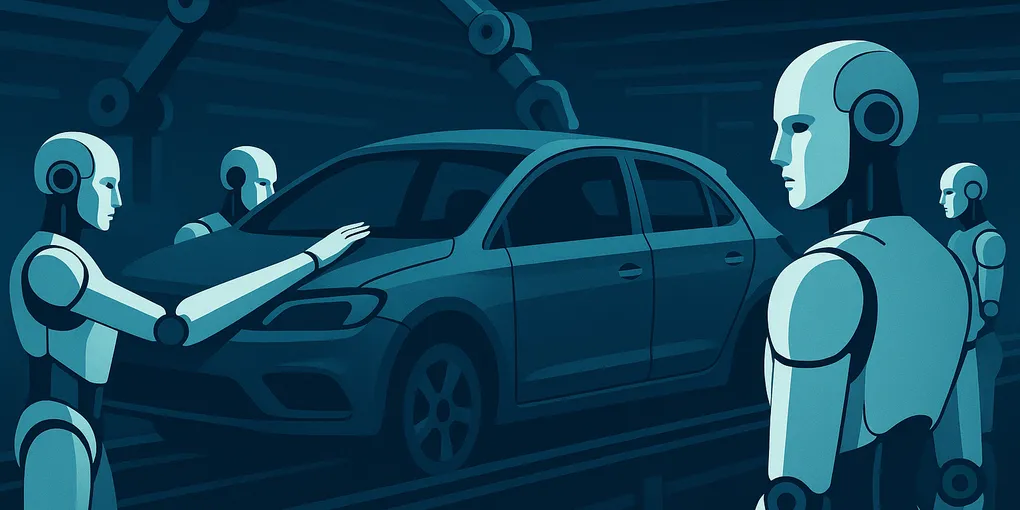
In April 2026, Hyundai announced a $26 billion commitment to U.S. AI and robotics infrastructure — one of the largest single industrial AI investments ever made. The centerpiece: deploying Boston Dynamics humanoid robots directly on Hyundai assembly lines by 2028. This isn’t a research pledge or a venture fund. It’s a production timeline backed by a major automaker that already owns the humanoid robot company.
Key Takeaways
- Hyundai pledged $26B in U.S. AI and robotics investment in April 2026
- Boston Dynamics humanoid robots are planned for Hyundai assembly lines by 2028
- Hyundai acquired Boston Dynamics in 2021 for approximately $1.1B
- Amazon acquired Fauna Robotics (“Sprout” humanoid) the same week
- Global humanoid robot market was under $1B in 2023; 2030 projections range $10B–$60B
What Is Hyundai Actually Committing To Build?
The $26B spans AI infrastructure, robotics R&D, and production facilities. The headline move is deploying Boston Dynamics humanoid robots directly into Hyundai’s manufacturing operations — not as a pilot, but as planned operational deployment within two years.
The same week, Amazon confirmed its acquisition of Fauna Robotics and its “Sprout” humanoid platform to expand into consumer and service robotics. The signal from multiple major players is consistent: the humanoid robot deployment phase has begun.
Why Does Hyundai’s AI and Robotics Bet Matter Beyond Auto Manufacturing?
Hyundai’s move is a proof of concept for every industry relying on physical labor in structured environments:
- Warehousing and logistics — the same robot handling car parts can handle packages
- Healthcare support — moving equipment, restocking supplies, routine physical tasks
- Food and hospitality — repetitive prep work in controlled kitchen environments
- Retail and fulfillment — the Amazon/Fauna acquisition points directly here
The convergence of improved dexterity (Boston Dynamics has spent 30+ years on this), falling hardware costs, and better AI for object manipulation means 2026–2028 is when industrial humanoids are likely to cross from expensive experiments to justifiable capital investments.
How Did Boston Dynamics Become This Important?
For years, Boston Dynamics was seen as a fascinating but commercially distant research project — viral robot videos with not much revenue. Hyundai’s acquisition in 2021 for roughly $1.1 billion looked questionable to some analysts at the time.
That thesis is now validated. Hyundai didn’t just buy a brand — it bought a 30-year head start on locomotion, manipulation, and real-world robot reliability. The $26B commitment represents Hyundai betting that this technology is ready to move from the lab to the factory floor. For context on what humanoid robots are actually doing in workplaces today, see our broader look at humanoid robot deployment in 2026.
What Does Amazon’s Fauna Robotics Acquisition Add?
Amazon acquiring Fauna Robotics broadens the story beyond heavy industry. Fauna’s “Sprout” humanoid was designed for lighter-touch environments — homes, hospitals, retail. Amazon’s distribution network, data infrastructure, and operational scale give Sprout a path to real-world deployment that most robotics startups couldn’t achieve independently.
Amazon already runs tens of thousands of wheeled and arm robots across its fulfillment centers. Adding a humanoid platform signals planning for environments where those robots can’t reach — anywhere designed around human movement.
What Is the Actual Investment Case for Humanoid Robotics?
A few numbers worth tracking:
- Global humanoid robot market was under $1B in 2023; analyst projections for 2030 range from $10B to $60B depending on deployment pace
- Hyundai’s $26B commitment alone is larger than the current entire market
- Unit economics improve dramatically with scale — the first 1,000 robots are expensive; the 100,000th is not
The $26B headline is less important than the 2028 production timeline. That’s when we’ll know if the economics work at scale in a demanding real-world environment.
What Should Operators and Decision-Makers Do Now?
If you run a business with physically repetitive tasks in a structured environment, this is directly relevant to your next 5-year planning cycle. Not because you’ll be buying humanoid robots tomorrow — but because:
- Labor cost assumptions built into long-term models may shift significantly as robot prices drop
- Facility design should account for robot-compatible layouts; retrofitting later is expensive
- Supply chain vendors and competitors will adopt this technology; awareness builds strategic advantage
The companies that win won’t be those who ignore this until it’s unavoidable. They’ll be the ones who start experimenting with smaller robotics and automation today, building operational knowledge to absorb humanoid tools when the price/performance ratio crosses the threshold.
That threshold is closer than most businesses think. The AI transformation happening across software is now being matched by a physical-world transformation in manufacturing — a convergence also visible in the broader AI agent rollouts entering enterprise operations.
Frequently Asked Questions
Why is Hyundai investing $26 billion in U.S. AI and robotics?
Hyundai is betting that humanoid robots will transform manufacturing economics. The investment funds AI infrastructure, robotics R&D, and production facilities — including deploying Boston Dynamics humanoid robots on assembly lines by 2028. It signals a strategic push to lead the humanoid robot market before it fully matures, with projections ranging from $10B to $60B by 2030.
When will humanoid robots actually appear in Hyundai factories?
Hyundai plans to have Boston Dynamics humanoid robots operating on assembly lines by 2028. That two-year timeline is the more actionable signal — it means real-world industrial deployment is imminent, not speculative. The 2028 production date is the concrete milestone to watch.
How big is the humanoid robot market right now?
The global humanoid robot market was under $1 billion in 2023. Projections for 2030 range widely — from $10 billion conservatively to $60 billion on the high end. That spread reflects genuine uncertainty about how fast deployment timelines, costs, and adoption rates will shift as major manufacturers scale up.
What should businesses do in response to this robotics push?
Two practical moves: revisit long-term labor cost models, since widespread humanoid deployment could shift wage and headcount assumptions by the late 2020s. And factor robot-compatible layouts into any facility planning happening now — retrofitting later costs more. You don’t need to act immediately, but decisions made in 2026 will outlast the current labor landscape.
Hyundai’s $26B investment was announced April 2026. Boston Dynamics humanoid robots are planned for Hyundai assembly lines by 2028. Amazon confirmed the Fauna Robotics acquisition the same week.