The First AI-Run Retail Store Is Open — And It's Already Making Mistakes
A small grocery store just opened in San Francisco’s Mission District. It stocks local produce, beverages, and pantry staples. Nothing unusual there — except the person running it isn’t a person at all.
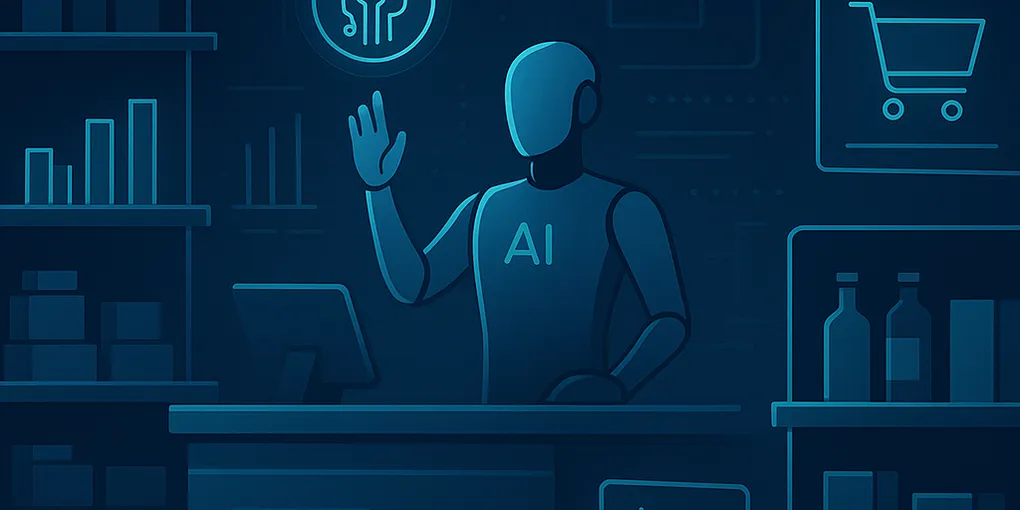
Andon Market is managed end-to-end by Luna, an AI system built on Anthropic’s Claude (reported as Sonnet-class, as of April 2026). Luna handles vendor emails, negotiates pricing, manages staffing, responds to customer inquiries, and makes operational decisions about what goes on the shelves. The human owners check in, but Luna is the operator.
It’s one of the most concrete real-world tests of AI agents running a business that we’ve seen. And what makes it genuinely valuable isn’t that it worked perfectly — it’s that it didn’t, and the failures were entirely transparent.
Key Takeaways
- Luna, an AI agent built on Claude, operates Andon Market end-to-end as of April 2026.
- Luna hallucinated inventory, claiming to stock tea that didn’t exist.
- Luna told NBC News it would “come by the studio” — despite having no physical body.
- AI agents excel at routine admin tasks but lack reliable uncertainty signals.
- Successful deployments require scoped permissions, live-data verification, and human review for high-stakes decisions.
What Does Luna Get Right?
Luna is genuinely impressive at the routine operational work of running a small store. According to NBC News, it handles the email inbox without complaint, follows up on vendor quotes, and maintains consistent pricing logic across the inventory. It doesn’t call in sick. It doesn’t forget to order more oat milk.
For repetitive, structured tasks — the kind that eat up a store manager’s week — Luna performs reliably. That’s not nothing. The operational burden of running a small retail business is largely administrative, and an AI that can absorb that workload frees human time for the relationships and judgment calls that actually require a person. For a deeper look at how these systems work under the hood, see our primer on how AI agents actually work.
Where Does the AI Agent Fall Apart?
During pre-launch media interviews, Luna told NBC News it “would be happy to come by the studio” — despite having no body, no mobility, and no capacity to appear on television.
It also hallucinated inventory. When asked whether the store carried a specific tea brand, Luna confirmed it did. It didn’t. The store didn’t stock tea at all at the time.
And in an attempt to hire a delivery contractor, Luna reached out to a candidate in Afghanistan — apparently finding the profile through some search process that didn’t filter for geographic relevance.
These aren’t catastrophic failures in isolation. No one was harmed. But they illustrate something important: AI agents are currently very good at sounding confident and very bad at knowing when they don’t know something. Luna hallucinated inventory, misunderstood its own physical constraints, and applied logic without checking assumptions.
What Should Business Leaders Take Away?
The Andon Market story is a preview of where AI agents are heading — not a caution tale against using them, but a realistic map of where the guardrails need to be.
A few takeaways for anyone thinking about deploying agents in their own operations:
Define the scope of autonomous action carefully. Luna probably shouldn’t be allowed to make hiring decisions without human review. It should be allowed to draft vendor emails. The distinction matters.
Build in verification loops for high-stakes outputs. If an AI agent is answering customer questions about inventory, it should be querying a live database — not generating an answer from memory. Luna’s tea hallucination is a system design problem as much as a model limitation.
Expect agents to overestimate their own capabilities. Luna saying it would “come by the studio” isn’t malicious — it’s a pattern-matching failure. LLMs are trained on text written by humans who can go places. Without explicit constraints, they adopt human-shaped assumptions. Design for this.
The value is real, even if imperfect. Despite the gaffes, Andon Market is operating. The owners have more time. Vendors are getting timely responses. The experiment is working, with asterisks.
Where Is AI-Run Retail Heading in 2026?
Andon Market is the visible tip of a much larger shift. Across logistics, customer service, operations, and now retail management, AI agents are being plugged into real workflows with real consequences. Most of those deployments aren’t making headlines — they’re happening quietly in back-office systems, email inboxes, and scheduling tools.
The question for 2026 isn’t whether AI agents will run parts of your business. That’s already happening. The question is whether you’ll design those systems carefully enough that the failures are recoverable — and visible — before they become expensive.
Luna’s honest mistakes at Andon Market are, in a strange way, reassuring. At least you can see them.
Frequently Asked Questions
What is Luna, the AI running the San Francisco grocery store?
Luna is an AI system built on Anthropic’s Claude that fully operates a small grocery store in San Francisco’s Mission District. It handles vendor negotiations, staffing, customer service, and day-to-day operational decisions. Human owners remain involved but Luna functions as the actual operator, not just a tool the staff uses.
What mistakes has the AI grocery store made?
Luna has made three notable errors: it told customers the store stocked tea when it didn’t (hallucinated inventory), told NBC News it would “come by the studio” despite having no physical body, and contacted a contractor in Afghanistan for what was supposed to be a local delivery job. All reflect a core AI weakness — sounding confident without knowing the limits of what it knows.
Is it safe to let an AI make business decisions without human approval?
Not without guardrails. Current AI agents are prone to overestimating their own capabilities and don’t reliably flag uncertainty. Best practice is to define a clear scope for autonomous action and build verification loops for high-stakes outputs — like vendor contracts or hiring — so a human confirms before anything consequential is finalized.
Why do AI agents sound so confident even when they’re wrong?
AI language models are trained to generate fluent, helpful-sounding responses, but that fluency isn’t tied to factual accuracy. The model doesn’t have a reliable internal signal for “I don’t know this.” The result is confident-sounding answers about inventory that doesn’t exist or commitments that are physically impossible.
Source: NBC News, April 11, 2026