AI Coding Tools Are Cutting Dev Time by 46% — and the Competition Is Just Getting Started
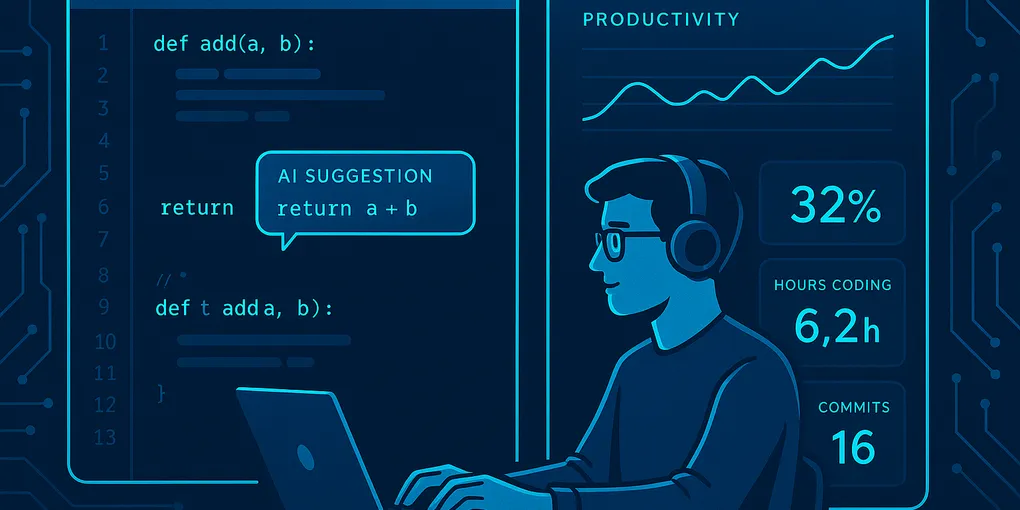
Software development is being transformed faster than almost any other profession — and new data makes the scale of that shift concrete. According to McKinsey research, AI coding tools reduce time spent on routine coding tasks by roughly 46%. This isn’t a marginal improvement — it’s a structural change to how software gets built.
Key Takeaways
- AI coding tools reduce routine dev time by ~46%, according to McKinsey research (2026).
- Solo founders can now ship SaaS in a weekend; small agencies do with 1–2 devs what used to require 3–4.
- Claude Code, OpenAI Codex CLI, and Google Gemini CLI dominate; competition is now about workflows, not code quality.
- Security caveat: AI-generated code sometimes misses edge cases and vulnerabilities — human review is essential before production.
- The hiring calculus is changing: teams get more capability per developer, not fewer developers overall.
How Much Faster Is Development Actually Getting?
McKinsey’s survey of 4,500+ developers found that AI coding tools reduce time spent on routine coding tasks by an average of roughly 46%. By early 2026, reported data suggests that a significant percentage of code commits on GitHub are either AI-generated or substantially AI-assisted.
The implications are concrete:
- Solo founders with no engineering background are now shipping SaaS products in a weekend
- Small agencies that previously needed 3–4 developers to staff a project are doing it with 1–2
- Internal tools that used to take months are being prototyped and shipped in days
- Startups can launch with smaller technical founding teams and move faster
This isn’t about replacing developers. It’s about dramatically multiplying what each developer can do.
Which AI Coding Tools Are Actually Winning?
The AI coding assistant race is now a three-way competition between:
Claude Code (Anthropic) — Captured an early lead among professional developers. Known for deep context retention across large codebases, strong reasoning about architecture decisions, and a terminal-first workflow that appeals to power users. Claude Code’s strength is depth: it thinks through what you’re asking, not just what you typed.
Codex CLI (OpenAI) — Launched mid-2025 and closed the gap fast. OpenAI’s integration with its broader ecosystem (ChatGPT, GPT-4o, the OpenAI API) gives Codex a distribution advantage. Developers already inside the OpenAI stack tend to default here.
Gemini CLI (Google) — The dark horse. Google’s access to massive codebases and its deep integration with Android Studio, Firebase, and Google Cloud makes Gemini CLI especially powerful for mobile and cloud-native development. Recent updates have made it competitive on general coding tasks too.
What’s notable: the race is no longer primarily about which model writes better code. All three are good enough. The competition has shifted to:
- Agentic workflows — Can the tool autonomously complete multi-step tasks (write, test, debug, deploy) without constant hand-holding?
- IDE integration — VS Code, JetBrains, Vim/Neovim. Which tool disappears into your existing setup?
- Context management — How well does the assistant understand a large, complex, real-world codebase rather than just a single file?
This is part of the broader AI agents trend transforming software development.
What Does This Mean for Business Leaders?
If you’re running a software company, product team, or technology organization, here’s the practical read:
Hiring math is changing. A strong developer with good AI tooling may now deliver what used to require two. This doesn’t mean layoffs — it means you can do more with the same team, or build things you previously couldn’t afford to.
Non-technical founders have more leverage than ever. The barrier to building software has dropped significantly. If you have a product idea and some determination, the tools now exist to move from idea to working prototype without a technical co-founder — at least to a point.
Internal tool backlogs are shrinking. Many companies have long lists of internal tools they “always wanted to build but never had the engineering bandwidth for.” AI coding tools are making those tractable. The ROI on internal tooling just improved dramatically.
Security and code quality need more attention, not less. More code, faster, doesn’t automatically mean better code. McKinsey’s research noted that AI-generated code tends to pass syntax checks but sometimes misses edge cases, security considerations, or architecture-level issues. Strong code review practices matter more, not less. See our analysis of AI security risks for more context.
The Bottom Line
The AI coding revolution isn’t coming — it already arrived. The roughly 46% reduction in routine dev time is being captured by companies that moved early. The question for everyone else is how quickly they close the gap.
The tool wars between Claude Code, Codex, and Gemini CLI are ultimately good for developers: competition drives rapid improvement, and all three are better today than they were six months ago.
Pick one. Learn it deeply. The productivity gains are real — and if you’re not using one of these tools yet, your competitors might be.
Frequently Asked Questions
How much time do AI coding tools actually save developers?
According to McKinsey research, AI coding tools cut routine development time by roughly 46%. This applies to repetitive tasks like boilerplate code, unit tests, and standard implementations — not necessarily complex architecture decisions or novel problem-solving.
What are the top AI coding tools competing right now?
The three main competitors are Claude Code (Anthropic), OpenAI Codex CLI, and Google Gemini CLI. Competition has moved beyond raw code quality — the real battleground is now agentic workflows, IDE integration, and how well each tool manages context across large codebases.
Is AI-generated code safe to use in production?
Not without review. AI coding tools sometimes miss edge cases and security vulnerabilities, meaning code that looks correct can still have flaws. Teams should treat AI output as a first draft — useful for speed, but requiring human review before shipping to production.
Do AI coding tools mean companies will hire fewer developers?
The hiring math is shifting, but it’s less about fewer developers and more about changed expectations. A smaller team can now ship what previously required a larger one. Non-technical founders also gain more leverage, and internal tool backlogs are finally becoming manageable.
Sources: McKinsey, “Unleash developer productivity with generative AI” (2026); Code Pulse Weekly, “GitHub Reveals AI-Generated Code Now Makes Up Majority of Commits” (2026)