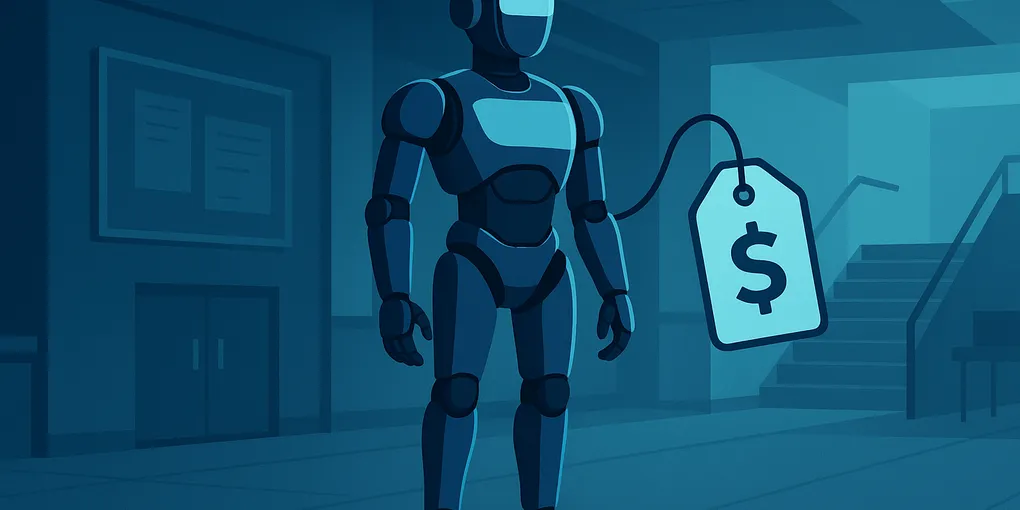
The $5,000 Humanoid Robot Is Here — and It Changes the Calculus for Business
Eighteen months ago, a functional humanoid robot cost $150,000 or more. Today, you can buy one for under $5,000. That price drop is not a marketing stunt — it reflects a genuine convergence of hardware and software advances that is opening up entirely new markets.
What Changed
Forbes recently profiled the new wave of sub-$5,000 humanoid robots now available to consumers and businesses. Six specific shifts explain why 2026 is different from every previous “year of the robot” that never quite arrived:
1. Integrated joint modules. The most expensive part of a humanoid robot used to be its joints — precision-engineered assemblies that combined motors, sensors, and gearing. New integrated joint modules combine high-torque brushless motors with strain wave gearing into a single, mass-produced unit. Cost per joint dropped by ~70% in two years.
2. On-device AI inference. You no longer need a cloud connection for a robot to navigate a room, pick up an object, or respond to a basic instruction. Dedicated edge AI chips (NVIDIA Jetson Orin, Qualcomm Robotics RB5) run vision and motion models locally. This removes latency, reduces operating costs, and eliminates privacy concerns around sending camera feeds to the cloud.
3. Open-source motion libraries. Locomotion — the hardest part of making a robot walk, balance, and recover from stumbles — used to require years of proprietary research. GitHub now hosts mature, battle-tested motion libraries that new entrants can build on rather than starting from scratch.
4. Standardized hardware platforms. Several manufacturers are now building on shared hardware specifications, which drives component costs down through scale. The same actuators powering a $4,800 educational robot also appear in a $12,000 warehouse assistant.
5. Competitive pressure from China. Chinese manufacturers (including Unitree, DEEP Robotics, and the team behind the Tien Kung Ultra) have aggressively pushed price floors down. The Tien Kung Ultra recently set a sprint record at the World Humanoid Robot Games — at a price point that would have been unthinkable in 2023.
6. Better simulation-to-reality transfer. Training robots in simulation (rather than real-world trial and error) has become significantly more effective. New models can transfer skills from simulated environments to physical robots with far fewer real-world correction cycles, reducing the R&D cost per capability.
Who Is Buying
Three markets are absorbing these robots fastest:
Schools and universities. Educational robotics programs that previously relied on simple arm robots or wheeled platforms are upgrading to bipedal humanoids. A sub-$5,000 price point is within the budget of a well-funded high school robotics program or a university engineering department. The combination of humanoid form factor and programmable AI behavior creates richer learning experiences than earlier generations of educational robots.
Small warehouses and logistics operations. Not every warehouse can afford a $75,000 Boston Dynamics Spot or a $250,000 Figure 02. Affordable humanoids are finding a niche in smaller operations — local distribution centers, specialty fulfillment operations, and facilities where the ROI on a full enterprise deployment doesn’t pencil out but a $5,000 assistant might.
Research labs and startups. The drop in hardware cost is accelerating AI robotics research. Teams that previously needed a $500K grant to buy a test platform can now prototype with off-the-shelf hardware. This is compressing the cycle time between research and deployment.
The Enterprise Signal: Hyundai and Boston Dynamics
The affordable tier isn’t the only story. At the high end, Hyundai Motor Group just reaffirmed plans to deploy Boston Dynamics Atlas robots to U.S. manufacturing plants by 2028. The announcement — reinforced at CES 2026 — signals that enterprise-scale humanoid deployment is on a concrete timeline, not just a roadmap slide.
When Hyundai commits its own factories to humanoid robots, that’s a supply chain signal. It means demand projections are real enough to justify manufacturing scale, which further drives costs down across the industry.
What It Means for Schools Specifically
For education-focused programs, the timing is notable. The National Education Summit (Brisbane, May 2026) has AI and robotics integration as a major focus. Schools are increasingly looking for ways to teach students to work with AI systems — not just learn about them from a textbook.
A sub-$5,000 humanoid robot that can be programmed, repaired, and upgraded by students provides exactly that kind of hands-on experience. It also aligns well with employer expectations: companies hiring in 2028 and beyond will increasingly expect workers who understand how to supervise, instruct, and collaborate with robotic systems.
The Bottom Line
The humanoid robot price floor has broken. Sub-$5,000 machines are real, functional, and available now. The six hardware and software shifts driving this aren’t temporary — they represent structural improvements that will continue pushing prices down and capability up.
For business leaders: the window to explore robotics at low cost is open. You don’t need a $1M pilot program to understand what these machines can and can’t do in your environment. A $5,000 investment can generate real operational learning.
For educators: the timing aligns with where the workforce is heading. Students who learn to work with humanoid robots in 2026 will have a meaningful edge in almost every industry that involves physical operations.
The robots are no longer coming. They are already here — and increasingly, within reach.
Sources: Forbes, “The Most Affordable Humanoid Robot You Can Buy Right Now” (April 2026); Interesting Engineering, China’s Tien Kung Ultra sprint record (April 2026); StarNews Korea, Hyundai Boston Dynamics Atlas deployment (April 2026)